Industrial Refrigeration in Poland’s Food Industry: Why Modernization Matters Now
2026-06-09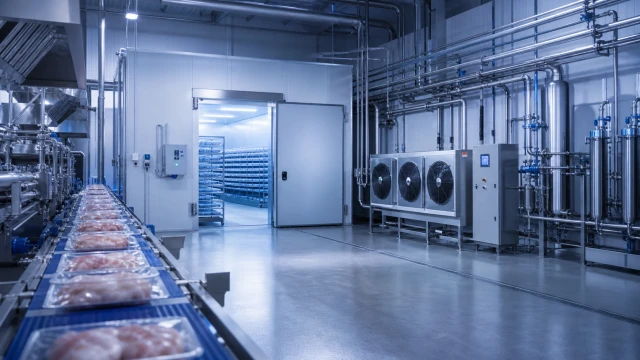
Poland’s food industry is moving through a clear modernization cycle, and industrial refrigeration is becoming one of the most important parts of that shift. Manufacturers are no longer evaluating refrigeration only in terms of cooling performance. Today, they also look at energy efficiency, process stability, maintenance risk, refrigerant strategy, and long-term compliance with European regulations.
This change is not happening in isolation. According to research cited by 300Gospodarka, around 35 percent of small and medium-sized food companies in Poland plan to invest in machinery and equipment modernization and in production automation, while 37 percent have already increased spending on renewing their machinery fleet. The same report notes that stronger investment in machinery and automation has improved the competitiveness outlook of the surveyed companies.
For food processors, refrigeration is closely connected with that broader investment logic. In real production environments, refrigeration supports much more than storage. It affects raw material handling, process continuity, packaging operations, finished goods quality, and the ability to keep temperature-sensitive products within specification from production to dispatch.
That is why industrial refrigeration should now be treated as a strategic production asset rather than a background utility. In sectors such as dairy, meat processing, beverage production, frozen foods, and cold-chain logistics, even minor inefficiencies in cooling can translate into product losses, downtime, unnecessary energy consumption, and higher operational costs.
A second major driver of change is the new European F-gas framework. Regulation (EU) 2024/573 was adopted on 7 February 2024 and entered into force on 11 March 2024, replacing the previous Regulation (EU) 517/2014. The new regulation strengthens rules on F-gas production, use, recovery, recycling, destruction, certification, training, imports, exports, and the placing on the market of equipment containing F-gases or relying on them for operation.
From a buyer’s perspective, this is not just a legal update. It has direct implications for equipment selection, servicing, documentation, and future operating costs. The regulation states that from 2025, refrigerators and freezers for commercial use containing F-gases with a GWP of 150 or more are added to the placing-on-the-market prohibition list, and from 2026 the list expands further to domestic refrigerators, freezers, and self-contained refrigeration equipment, except chillers.
The servicing side also becomes more important. Under the same regulation, from 2025 the use of F-gases with a GWP of 2500 is prohibited for the maintenance or servicing of refrigeration equipment. In parallel, labeling obligations under the new framework apply from 1 January 2025, and leak-checking rules are tightened through lower thresholds and broader equipment coverage.
For companies in the Polish food industry, this means refrigeration decisions increasingly require a longer time horizon. Buyers are asking more detailed questions before acquiring equipment: which refrigerant is used, how easy the unit will be to maintain, whether parts and service expertise will remain available, and whether the machine still makes sense under the current regulatory path.
This is one reason why interest in lower-GWP and natural refrigerants continues to grow. Industry sources identify ammonia, carbon dioxide, and hydrocarbons such as propane as key alternatives in refrigeration systems designed for lower environmental impact and better long-term positioning. The practical relevance of these refrigerants is especially visible in food processing, where efficiency, process reliability, and temperature control must work together.
Still, modernization does not mean that every plant needs a full replacement project at once. In many cases, the right move is a technical review of the current installation, followed by selective replacement, retrofit planning, or the purchase of professionally assessed used equipment that fits both the production process and the investment budget. That approach is especially relevant in the SME segment, where companies want measurable gains in performance and efficiency without overextending capital expenditure.
This creates a practical opportunity in the market. Buyers are no longer interested only in whether a refrigeration unit works today. They want to know whether it will continue to be a sound operational and commercial choice over the next several years. That makes technical condition, refrigerant type, serviceability, documentation, and integration potential far more important in the sales conversation than before.
For suppliers and equipment traders, the message is clear. The most valuable machines are those that can be positioned not just as available assets, but as solutions to current production and compliance challenges. When a refrigeration unit or food processing machine supports efficiency, continuity, and future readiness, it becomes easier to justify as an investment rather than a cost.
In Poland, this matters now because the modernization trend is already visible. Companies in the food sector are investing in machinery, renewing their equipment base, and increasing automation to strengthen competitiveness. At the same time, EU refrigeration regulation is becoming stricter, which pushes buyers to evaluate cooling systems more carefully and with better technical awareness.
For that reason, 2026 is a strong moment to review refrigeration assets across the food industry. Plants that modernize early can improve energy performance, reduce service risk, strengthen process reliability, and prepare more confidently for future market and regulatory demands. In a competitive manufacturing environment, refrigeration is no longer a secondary technical detail. It is part of production strategy.
Author
Marcin Białczyk is an engineer, technologist, surveyor, and founder focused on industrial machinery, refrigeration systems, and technical equipment for manufacturing and food processing applications. His work combines practical market knowledge with technical evaluation of machinery used in production, storage, and industrial process environments.
Looking for Food processing machinery?
Browse our marketplace for verified used industrial equipment. Direct contact with sellers. No commission.
Content added:
 BIAŁCZYK Sp. z o.o.
News
Fuel crisis 2026: What it means for Europe’s metalworking industry
Fuel Crisis 2026 is increasing costs across Europe’s metalworking industry. Learn the main risks and used machinery opportunities. Read more
Industrial Refrigeration in Poland’s Food Industry: Why Modernization Matters Now
Poland’s food industry is increasing investment in machinery modernization and automation, while the EU’s new F-gas rules are pushing food manufacturers to review refrigeration equipment more carefully. As a result, industrial refrigeration is becoming a strategic upgrade area for companies that want better efficiency, compliance, and long-term production reliability Read more
Buyer's Guide: How to Choose the Right CNC Lathe for Your Shop
Choosing a CNC lathe is one of the most important investment decisions in any metalworking shop. Whether you're starting a business or expanding your machine fleet, the purchase requires analyzing many technical and economic parameters. Read more
How European Metalworking Shops Can Win in the New Industrial Era
European metalworking companies can leverage reindustrialisation, nearshoring and booming demand in energy, e‑mobility and defence to move into higher‑margin, long‑term contracts. By specialising, upgrading their machine park (including with used machines) and professionalising quality and sales, they can modernise quickly with support from platforms like wesellmachines.com led by eng. Marcin Białczyk Read more

What is currently happening in the European industry at the turn of February 2026?
Discover how the rising PMI index and the new EU Industrial Accelerator Act impact machine valuation in 2026. Appraiser Marcin Białczyk from wesellmachines.com analyzes market trends, replacement value, and functional obsolescence of CNC equipment in the Industry 4.0 era. Read more
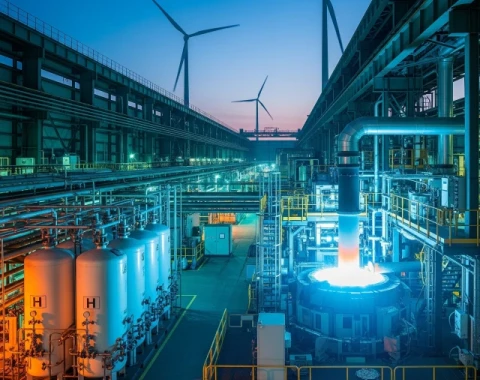
The Green Steel Revolution: A Strategic Analysis of Industrial Transformation
Strategic analysis of the steel sector's shift to green steel. Expert Marcin Białczyk explores DRI and EAF technologies, Fit for 55, CBAM, and industrial machinery valuation challenges in the era of decarbonization and ESG requirements. Read more
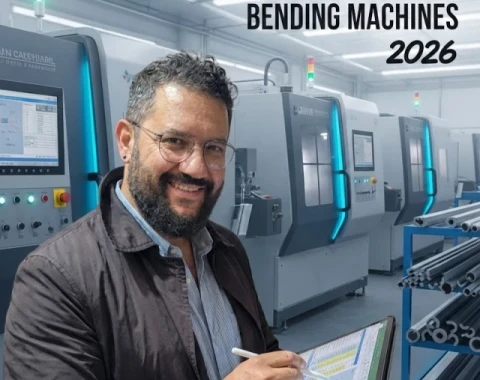
Valuation of Modern Tube and Profile Bending Machines in 2026
Marcin Białczyk (wesellmachines.com) redefines CNC bender valuation for 2026. Key takeaway: All-Electric technology and IIoT data drive higher residual value through extreme precision (±0.05°) and energy efficiency (50% savings). The guide bridges technical appraisal with 2026 funding paths (FENG, BGK) for the manufacturing sector. Read more
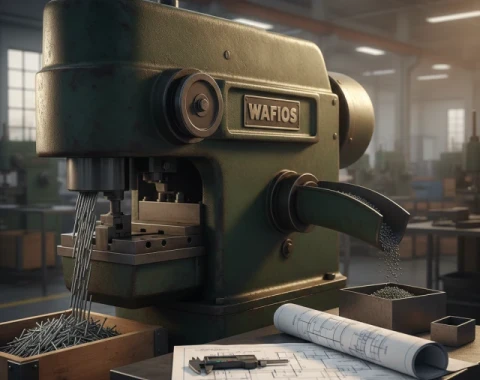
Nail Machine Valuation: What Are You Actually Buying? Expert Analysis
In my daily work at WeSellMachines, I frequently encounter a question that, on the surface, seems entirely rational: "Marcin, why does this 20-year-old Wafios automatic machine cost €40,000, when I can get a brand new machine with similar output from an Asian importer for €15,000?" Read more

How to Buy a Used Multi-Rip Saw and Revolutionize Your Sawmill
The secondary market for woodworking machinery is vast but full of traps. As an expert who has seen hundreds of machines "painted for sale" but destroyed on the inside, I have prepared this comprehensive guide for you. This isn't marketing fluff, but a solid dose of engineering knowledge that will allow you to independently assess the technical condition of a machine. Read more
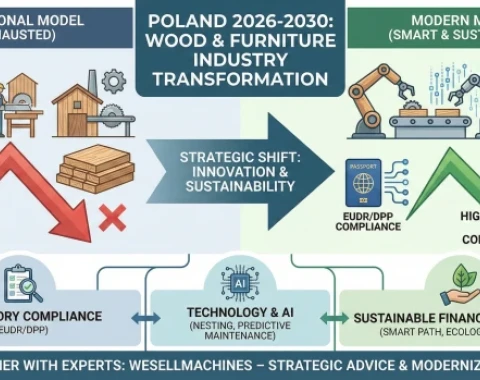
The End of the "Cheap Furniture" Era? Your Survival and Growth Strategy for 2026–2030
For decades, the Polish wood and furniture industry has been the undisputed leader in exports, generating an impressive €16.3 billion in 2024. We were the "furniture factory for Europe," winning on price, raw material availability, and skilled labor. However, as a practitioner who visits your plants daily, I see it clearly: this model is running out of steam. Read more
Executive Summary: The State of Play for 2025
The metalworking sector is entering a phase defined in macroeconomic analyses as the "Hyper-Efficiency Era." With industrial sentiment indices fluctuating and steel consumption forecasts showing only marginal growth (+2.2%), the margin for investment error has effectively vanished. At wesellmachines.com, we identify a fundamental paradigm shift: a transition from a Growth-at-all-costs strategy to Asset Utilization & Cash Flow Protection. In this report, we analyze why the key to survival in 2025-2026 is not buying "new," but buying "efficient"—often from the secondary market. Read more

How to Choose a Used Wood CNC Machining Center? A Complete Machine Audit Step-by-Step
Buying a used wood CNC machining center is a huge opportunity, but also a massive risk. Pervasive MDF dust destroys key components, and the cost of repairing a spindle or vacuum pump is staggering. This complete guide (5000+ words) is a professional technical audit in a nutshell. We will teach you how to inspect the machine step-by-step—from spindle diagnostics and vacuum table leak tests to assessing mechanics and controls. Avoid a costly mistake and make an informed investment with our expert checklist. Read more

The Complete Guide: How to Buy a Used CNC Press Brake and Not Regret the Investment
Buying a used CNC press brake is a strategic but risky investment. This article is a complete guide that explains, step-by-step, how to conduct a professional technical inspection to minimize risk. The author, an expert with 20 years of experience, describes the key elements to check: from evaluating the frame and hydraulics, through diagnostics of the CNC control, to verifying the completeness of the documentation. The article provides the necessary knowledge to make an informed and safe decision, helping to avoid costly mistakes. Read more

AI in European Industry: How Artificial Intelligence Shapes New Roles for Managers and Specialists (Competencies 2026)
The impact of Artificial Intelligence (AI) is a pivotal topic across the entire European manufacturing sector. From German automotive to French chemicals, enterprises throughout the European Union are actively implementing AI and Machine Learning (ML) solutions, leading to a revolution in job roles. This article analyzes how AI is transforming the roles of managers and specialists, shifting from routine tasks to predictive analytics and strategic system management. We outline the essential competencies needed to thrive in the era of Industry 5.0. Read more

Technological Audit of the Machine Park: Key to Increasing Efficiency (OEE) and Avoiding Legal Penalties
The technological audit is a strategic tool that allows companies to transform their equipment into a business asset. It focuses on 3 pillars: technology, processes (CT loss reduction, OEE), and Compliance (adherence to EU law). Regular investment leads to TCO reduction and increased machine lifespan, ensuring decisions are based on facts, not guesswork. Read more
 Log in with Facebook
 Log in with Google