Fuel crisis 2026: What it means for Europe’s metalworking industry
2026-06-17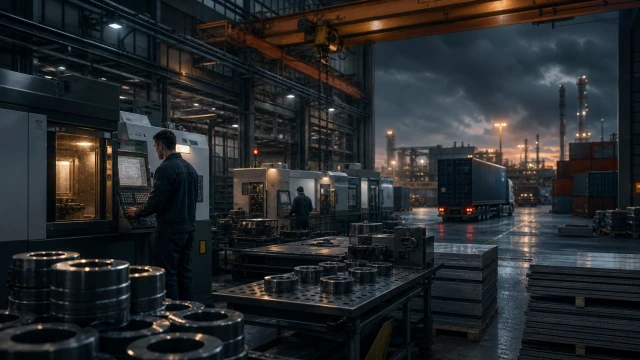
Fuel Crisis 2026: What It Means for Europe’s Metalworking Industry
By Marcin Białczyk, Engineer and industrial machinery market operator
European metalworking companies should respond to the 2026 fuel crisis in three ways: reduce energy intensity, secure more flexible supply chains and shift investment toward efficient or used machinery.
For many workshops, the immediate threat is not only higher electricity prices, but margin compression across transport, consumables and subcontracting. Companies that react early can protect cash flow and acquire productive assets at below-market prices.
Published: June 17, 2026 · Updated: June 17, 2026
Key takeaways
- The biggest short-term risk for metalworking companies is rising total operating cost, not only the headline fuel price.
- Energy-intensive plants and export-oriented subcontractors are the most exposed to margin pressure.
- Used machinery markets may benefit as factories delay new capex and sell surplus assets.
- Energy-efficient CNC equipment and automation become more attractive when power and labour costs stay elevated.
What is the main problem for metalworking companies in 2026?
The central problem is that the fuel crisis raises costs across the full production chain at the same time. Electricity, transport, lubricants, coolants, subcontracting and export logistics all become more expensive together, which makes it harder for manufacturers to defend margins.
For many companies, this is more dangerous than a temporary fall in demand. A factory can survive weaker orders for a period, but when every processed tonne, every machine hour and every shipment becomes more expensive, working capital pressure rises fast.
Why are energy and transport costs so damaging?
Metalworking is structurally energy-intensive. Furnaces, CNC machining centres, compressed air systems, welding equipment, extraction units and cooling systems all require stable energy input, so sudden cost spikes quickly affect unit economics.
Fuel costs also spread through the wider supply chain. Scrap, steel bars, sheet metal, profiles and finished components all move through road, port and warehouse networks, so higher diesel and freight rates function like a tax on every stage of industrial activity.
Which factories are most exposed?
The most exposed businesses are energy-intensive producers, export-heavy subcontractors and workshops with weak pricing power. Plants relying on high electricity consumption or narrow-margin contract work are usually less able to absorb prolonged cost inflation.
Companies with older machine fleets are also at a disadvantage. Legacy equipment often consumes more power, creates more downtime and makes it harder to compete when energy and maintenance costs rise together.
Why does this create a structural risk for European industry?
This crisis is not just a temporary fuel story. It reinforces a longer trend in which European manufacturers operate under higher structural energy and logistics costs than competitors in lower-cost regions.
If this pressure lasts into 2027, more firms may reduce shifts, postpone investment, move selected production abroad or liquidate underused assets. The long-term risk is not only lower profitability, but gradual loss of industrial capacity across parts of Europe’s manufacturing base.
Where are the best opportunities in used machinery?
Crisis conditions often create openings for disciplined buyers. Companies under financial pressure may sell machines, complete cells or production support equipment below fair market value, especially when they need liquidity quickly.
Most attractive opportunity areas
- Energy-efficient CNC machines: newer equipment with lower power draw, better servo systems and improved control efficiency.
- Automation assets: robotic welding cells, laser systems and CNC press brakes that reduce unit cost and improve repeatability.
- Distressed asset sales: machinery from suspended plants, downsizing operations or strategic relocations.
- Secondary market substitution: buyers replacing planned new-equipment purchases with quality used alternatives.
For machinery traders and industrial buyers, speed matters. The best opportunities usually go to operators who can inspect, price and execute cross-border transactions faster than slower corporate buyers.
What should metalworking companies do now?
The strongest response is operational, not rhetorical. Management teams should focus on measurable actions that reduce exposure within weeks, not only long-term strategy slides.
- Audit machine-level energy use to identify the least efficient assets and bottlenecks.
- Reprice contracts faster where energy and logistics clauses allow negotiation.
- Diversify suppliers and transport routes to reduce concentration risk.
- Compare retrofit versus replacement for older CNC and fabrication equipment.
- Monitor distressed sales for strategic used machinery purchases.
In this environment, the winners are usually the firms that treat machinery efficiency, procurement discipline and pricing response as one connected system.
Outlook to 2027
If fuel and energy market instability remains prolonged, European metalworking companies will need to plan around uncertainty rather than wait for a quick reset. That means cost resilience, supplier flexibility and asset efficiency become core competitive capabilities.
For buyers, manufacturers and machinery traders alike, 2026 to 2027 may become a period of forced adjustment, but also one of unusually strong opportunities in the used machinery market.
About the author
Marcin Białczyk is an engineer and industrial machinery market operator focused on used machinery trading, industrial asset valuation and cross-border equipment sourcing in Europe. He publishes practical market analysis for manufacturers, machinery buyers and industrial decision-makers through WeSellMachines.
WeSellMachines — your partner in industrial machinery trading across Europe.
Looking for Metal processing machinery?
Browse our marketplace for verified used industrial equipment. Direct contact with sellers. No commission.
Content added:
 BIAŁCZYK Sp. z o.o.
News
Fuel crisis 2026: What it means for Europe’s metalworking industry
Fuel Crisis 2026 is increasing costs across Europe’s metalworking industry. Learn the main risks and used machinery opportunities. Read more

Industrial Refrigeration in Poland’s Food Industry: Why Modernization Matters Now
Poland’s food industry is increasing investment in machinery modernization and automation, while the EU’s new F-gas rules are pushing food manufacturers to review refrigeration equipment more carefully. As a result, industrial refrigeration is becoming a strategic upgrade area for companies that want better efficiency, compliance, and long-term production reliability Read more
Buyer's Guide: How to Choose the Right CNC Lathe for Your Shop
Choosing a CNC lathe is one of the most important investment decisions in any metalworking shop. Whether you're starting a business or expanding your machine fleet, the purchase requires analyzing many technical and economic parameters. Read more

How European Metalworking Shops Can Win in the New Industrial Era
European metalworking companies can leverage reindustrialisation, nearshoring and booming demand in energy, e‑mobility and defence to move into higher‑margin, long‑term contracts. By specialising, upgrading their machine park (including with used machines) and professionalising quality and sales, they can modernise quickly with support from platforms like wesellmachines.com led by eng. Marcin Białczyk Read more

What is currently happening in the European industry at the turn of February 2026?
Discover how the rising PMI index and the new EU Industrial Accelerator Act impact machine valuation in 2026. Appraiser Marcin Białczyk from wesellmachines.com analyzes market trends, replacement value, and functional obsolescence of CNC equipment in the Industry 4.0 era. Read more
The Green Steel Revolution: A Strategic Analysis of Industrial Transformation
Strategic analysis of the steel sector's shift to green steel. Expert Marcin Białczyk explores DRI and EAF technologies, Fit for 55, CBAM, and industrial machinery valuation challenges in the era of decarbonization and ESG requirements. Read more
Valuation of Modern Tube and Profile Bending Machines in 2026
Marcin Białczyk (wesellmachines.com) redefines CNC bender valuation for 2026. Key takeaway: All-Electric technology and IIoT data drive higher residual value through extreme precision (±0.05°) and energy efficiency (50% savings). The guide bridges technical appraisal with 2026 funding paths (FENG, BGK) for the manufacturing sector. Read more
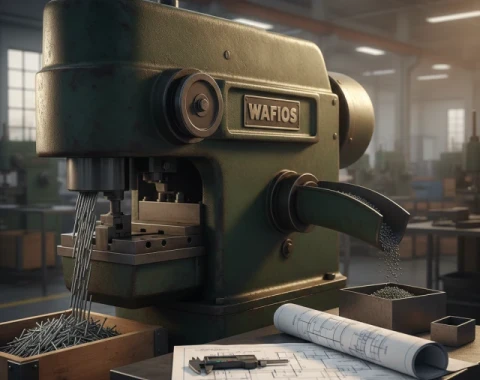
Nail Machine Valuation: What Are You Actually Buying? Expert Analysis
In my daily work at WeSellMachines, I frequently encounter a question that, on the surface, seems entirely rational: "Marcin, why does this 20-year-old Wafios automatic machine cost €40,000, when I can get a brand new machine with similar output from an Asian importer for €15,000?" Read more

How to Buy a Used Multi-Rip Saw and Revolutionize Your Sawmill
The secondary market for woodworking machinery is vast but full of traps. As an expert who has seen hundreds of machines "painted for sale" but destroyed on the inside, I have prepared this comprehensive guide for you. This isn't marketing fluff, but a solid dose of engineering knowledge that will allow you to independently assess the technical condition of a machine. Read more
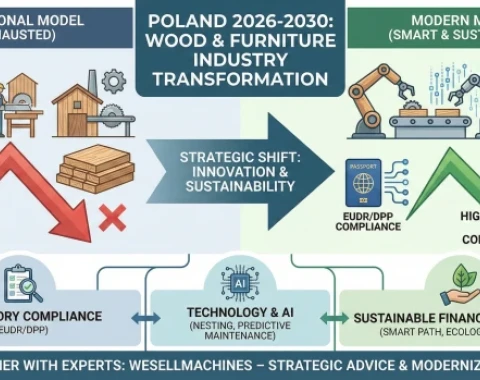
The End of the "Cheap Furniture" Era? Your Survival and Growth Strategy for 2026–2030
For decades, the Polish wood and furniture industry has been the undisputed leader in exports, generating an impressive €16.3 billion in 2024. We were the "furniture factory for Europe," winning on price, raw material availability, and skilled labor. However, as a practitioner who visits your plants daily, I see it clearly: this model is running out of steam. Read more
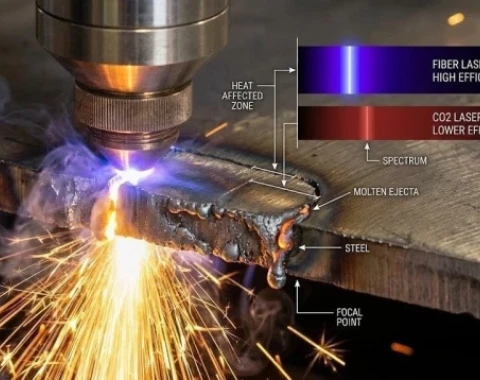
Executive Summary: The State of Play for 2025
The metalworking sector is entering a phase defined in macroeconomic analyses as the "Hyper-Efficiency Era." With industrial sentiment indices fluctuating and steel consumption forecasts showing only marginal growth (+2.2%), the margin for investment error has effectively vanished. At wesellmachines.com, we identify a fundamental paradigm shift: a transition from a Growth-at-all-costs strategy to Asset Utilization & Cash Flow Protection. In this report, we analyze why the key to survival in 2025-2026 is not buying "new," but buying "efficient"—often from the secondary market. Read more

How to Choose a Used Wood CNC Machining Center? A Complete Machine Audit Step-by-Step
Buying a used wood CNC machining center is a huge opportunity, but also a massive risk. Pervasive MDF dust destroys key components, and the cost of repairing a spindle or vacuum pump is staggering. This complete guide (5000+ words) is a professional technical audit in a nutshell. We will teach you how to inspect the machine step-by-step—from spindle diagnostics and vacuum table leak tests to assessing mechanics and controls. Avoid a costly mistake and make an informed investment with our expert checklist. Read more

The Complete Guide: How to Buy a Used CNC Press Brake and Not Regret the Investment
Buying a used CNC press brake is a strategic but risky investment. This article is a complete guide that explains, step-by-step, how to conduct a professional technical inspection to minimize risk. The author, an expert with 20 years of experience, describes the key elements to check: from evaluating the frame and hydraulics, through diagnostics of the CNC control, to verifying the completeness of the documentation. The article provides the necessary knowledge to make an informed and safe decision, helping to avoid costly mistakes. Read more

AI in European Industry: How Artificial Intelligence Shapes New Roles for Managers and Specialists (Competencies 2026)
The impact of Artificial Intelligence (AI) is a pivotal topic across the entire European manufacturing sector. From German automotive to French chemicals, enterprises throughout the European Union are actively implementing AI and Machine Learning (ML) solutions, leading to a revolution in job roles. This article analyzes how AI is transforming the roles of managers and specialists, shifting from routine tasks to predictive analytics and strategic system management. We outline the essential competencies needed to thrive in the era of Industry 5.0. Read more

Technological Audit of the Machine Park: Key to Increasing Efficiency (OEE) and Avoiding Legal Penalties
The technological audit is a strategic tool that allows companies to transform their equipment into a business asset. It focuses on 3 pillars: technology, processes (CT loss reduction, OEE), and Compliance (adherence to EU law). Regular investment leads to TCO reduction and increased machine lifespan, ensuring decisions are based on facts, not guesswork. Read more
 Log in with Facebook
 Log in with Google