The End of the "Cheap Furniture" Era? Your Survival and Growth Strategy for 2026–2030
2025-12-04
The End of the "Cheap Furniture" Era? Your Survival and Growth Strategy for 2026–2030
Author: Marcin Białczyk | Expert in Heavy Industry Machinery & Modernization
For decades, the Polish wood and furniture industry has been the undisputed leader in exports, generating an impressive €16.3 billion in 2024. We were the "furniture factory for Europe," winning on price, raw material availability, and skilled labor. However, as a practitioner who visits your plants daily, I see it clearly: this model is running out of steam.
We are facing a "perfect storm." Rising labor costs, regulatory pressure from Brussels, and sleepless competition mean that simple competitive advantages are no longer enough. In the years 2025–2030, the winners won't be those who cut the cheapest, but those who cut the smartest.
In today’s article, based on hard market data, I will show you how to turn upcoming regulations (EUDR, ESPR) into an advantage and why modernizing your current machinery park might be a better decision than buying new equipment.
1. Regulatory Tsunami: EUDR is Just the Beginning
Many of you ask me about the EUDR (European Union Deforestation Regulation). Although implementation deadlines have shifted (end of 2025 for large companies, mid-2026 for SMEs), treating this as a "holiday from regulations" is a strategic error.
EUDR marks the end of anonymous raw materials. Every board, every chipboard must have its digital geolocation history. But that's not all. On the horizon, we can already see the Digital Product Passport (DPP). From around 2027, furniture without a "digital twin"—containing data on carbon footprint and materials—may be blocked from the EU market.
What does this mean for your machines?
Traditional "paperwork" is becoming obsolete. Your machines—from sawmills to CNC centers—must become part of a digital ecosystem.
-
Integration: A modern production line must "know" what it is processing and automatically report it to the ERP system.
-
Identification: The necessity to implement marking systems (QR codes, RFID) integrated directly into the machining process.
Expert Tip: When investing in machinery, ask not just about mechanical output, but about Digital Connectivity. A machine that doesn't generate data becomes a "blind link" in the supply chain.
2. Artificial Intelligence on the Factory Floor – It’s Not Sci-Fi
Let's forget about AI generating images for a moment. The real revolution is happening in nesting optimization. In a traditional plant, material waste often reaches 20-30%. That is money thrown into the waste bin.
Industrial AI changes the rules of the game:
-
Machine Vision: Scanners analyze wood defects in real-time.
-
Learning Algorithms: The system plans the cut to maximize material yield, learning from thousands of previous operations.
Thanks to this, vision systems achieve a defect detection rate of 99.9%. This is not just raw material savings, but primarily the avoidance of costly complaints about the finished product.
3. Retrofitting: A Second Life for Your Machines
As a machinery valuation expert, I often face the dilemma: buy new or modernize the old? In these times of expensive financing, retrofitting is becoming the number one option.
Why is it worth it?
-
Economics: The cost of modernization is a fraction of the price of a new machine, yet it extends its life by 10–15 years.
-
Time: You avoid long waiting times for new equipment delivery.
-
Efficiency: Replacing controls and drives can increase the efficiency of an old machine body by 10–30%.
A Note on Safety:
Modernization is not just about replacing a PLC. Under the new EU Machinery Regulation, deep interference can legally make you the "manufacturer" of the machine. At WeSellMachines, we place immense emphasis on ensuring every retrofit goes hand in hand with adapting to Health & Safety requirements (guards, emergency stops), which is currently a prime target for labor inspections.
4. Don't Let Machines Stop: Predictive Maintenance
A spindle failure at the peak of the season is every production manager's nightmare. We are moving from a "fix it when it breaks" model to Predictive Maintenance.
Modern diagnostics include:
Shutterstock
-
Vibration Analysis: Detects bearing damage before it becomes audible to the ear.
-
Current Analysis: VFD errors (e.g., Overcurrent OC1) often signal winding or mechanical problems long before a critical failure.
5. How to Finance the Change? Investment Roadmap 2025–2026
Even the best technology requires a budget. Fortunately, the years 2025–2026 offer a wide range of support instruments in Poland. Here is a summary of the most interesting financial tools available to our clients:
| Financial Instrument | Target Group | What can funds be used for? | Benefit |
| SMART Path (FENG) | SMEs & Large Firms | Innovation, digitalization, greening | Grant up to 80% (depending on region) |
| Robotization Relief | All (PIT/CIT payers) | Industrial robots and peripherals | Deduct 50% of costs from the tax base |
| BGK Ecological Credit | SMEs | Machine modernization (energy savings >30%) | "Green premium" paying off part of the loan |
| ZUS Grants for Safety | Social Security Payers | Dust extraction, machine guards, noise reduction | Non-repayable grant for improving working conditions |
Summary: Partnership Instead of Just Sales
The market is changing, and we are changing with it. At WeSellMachines, we don't want to be just a supplier of "hardware." We understand that today you need a partner who will help you navigate the maze of regulations, select technology for specific EUDR requirements, and help optimize energy consumption in your plant.
The future of the industry lies in quality, data, and efficiency. Machines are just tools, but properly selected, they become the foundation of success.
What can I do for you?
Is your production hall ready for the challenges of 2025? Contact me directly. Let's analyze your machinery park regarding modernization potential, energy savings, and compliance with new safety standards.
Marcin Białczyk
Your partner in the world of heavy industry
Content added:
 BIAŁCZYK Sp. z o.o.
News
Fuel crisis 2026: What it means for Europe’s metalworking industry
Fuel Crisis 2026 is increasing costs across Europe’s metalworking industry. Learn the main risks and used machinery opportunities. Read more
Industrial Refrigeration in Poland’s Food Industry: Why Modernization Matters Now
Poland’s food industry is increasing investment in machinery modernization and automation, while the EU’s new F-gas rules are pushing food manufacturers to review refrigeration equipment more carefully. As a result, industrial refrigeration is becoming a strategic upgrade area for companies that want better efficiency, compliance, and long-term production reliability Read more
Buyer's Guide: How to Choose the Right CNC Lathe for Your Shop
Choosing a CNC lathe is one of the most important investment decisions in any metalworking shop. Whether you're starting a business or expanding your machine fleet, the purchase requires analyzing many technical and economic parameters. Read more
How European Metalworking Shops Can Win in the New Industrial Era
European metalworking companies can leverage reindustrialisation, nearshoring and booming demand in energy, e‑mobility and defence to move into higher‑margin, long‑term contracts. By specialising, upgrading their machine park (including with used machines) and professionalising quality and sales, they can modernise quickly with support from platforms like wesellmachines.com led by eng. Marcin Białczyk Read more

What is currently happening in the European industry at the turn of February 2026?
Discover how the rising PMI index and the new EU Industrial Accelerator Act impact machine valuation in 2026. Appraiser Marcin Białczyk from wesellmachines.com analyzes market trends, replacement value, and functional obsolescence of CNC equipment in the Industry 4.0 era. Read more
The Green Steel Revolution: A Strategic Analysis of Industrial Transformation
Strategic analysis of the steel sector's shift to green steel. Expert Marcin Białczyk explores DRI and EAF technologies, Fit for 55, CBAM, and industrial machinery valuation challenges in the era of decarbonization and ESG requirements. Read more
Valuation of Modern Tube and Profile Bending Machines in 2026
Marcin Białczyk (wesellmachines.com) redefines CNC bender valuation for 2026. Key takeaway: All-Electric technology and IIoT data drive higher residual value through extreme precision (±0.05°) and energy efficiency (50% savings). The guide bridges technical appraisal with 2026 funding paths (FENG, BGK) for the manufacturing sector. Read more
Nail Machine Valuation: What Are You Actually Buying? Expert Analysis
In my daily work at WeSellMachines, I frequently encounter a question that, on the surface, seems entirely rational: "Marcin, why does this 20-year-old Wafios automatic machine cost €40,000, when I can get a brand new machine with similar output from an Asian importer for €15,000?" Read more

How to Buy a Used Multi-Rip Saw and Revolutionize Your Sawmill
The secondary market for woodworking machinery is vast but full of traps. As an expert who has seen hundreds of machines "painted for sale" but destroyed on the inside, I have prepared this comprehensive guide for you. This isn't marketing fluff, but a solid dose of engineering knowledge that will allow you to independently assess the technical condition of a machine. Read more
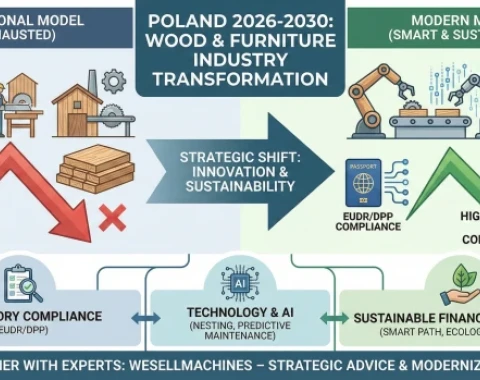
The End of the "Cheap Furniture" Era? Your Survival and Growth Strategy for 2026–2030
For decades, the Polish wood and furniture industry has been the undisputed leader in exports, generating an impressive €16.3 billion in 2024. We were the "furniture factory for Europe," winning on price, raw material availability, and skilled labor. However, as a practitioner who visits your plants daily, I see it clearly: this model is running out of steam. Read more
Executive Summary: The State of Play for 2025
The metalworking sector is entering a phase defined in macroeconomic analyses as the "Hyper-Efficiency Era." With industrial sentiment indices fluctuating and steel consumption forecasts showing only marginal growth (+2.2%), the margin for investment error has effectively vanished. At wesellmachines.com, we identify a fundamental paradigm shift: a transition from a Growth-at-all-costs strategy to Asset Utilization & Cash Flow Protection. In this report, we analyze why the key to survival in 2025-2026 is not buying "new," but buying "efficient"—often from the secondary market. Read more

How to Choose a Used Wood CNC Machining Center? A Complete Machine Audit Step-by-Step
Buying a used wood CNC machining center is a huge opportunity, but also a massive risk. Pervasive MDF dust destroys key components, and the cost of repairing a spindle or vacuum pump is staggering. This complete guide (5000+ words) is a professional technical audit in a nutshell. We will teach you how to inspect the machine step-by-step—from spindle diagnostics and vacuum table leak tests to assessing mechanics and controls. Avoid a costly mistake and make an informed investment with our expert checklist. Read more

The Complete Guide: How to Buy a Used CNC Press Brake and Not Regret the Investment
Buying a used CNC press brake is a strategic but risky investment. This article is a complete guide that explains, step-by-step, how to conduct a professional technical inspection to minimize risk. The author, an expert with 20 years of experience, describes the key elements to check: from evaluating the frame and hydraulics, through diagnostics of the CNC control, to verifying the completeness of the documentation. The article provides the necessary knowledge to make an informed and safe decision, helping to avoid costly mistakes. Read more

AI in European Industry: How Artificial Intelligence Shapes New Roles for Managers and Specialists (Competencies 2026)
The impact of Artificial Intelligence (AI) is a pivotal topic across the entire European manufacturing sector. From German automotive to French chemicals, enterprises throughout the European Union are actively implementing AI and Machine Learning (ML) solutions, leading to a revolution in job roles. This article analyzes how AI is transforming the roles of managers and specialists, shifting from routine tasks to predictive analytics and strategic system management. We outline the essential competencies needed to thrive in the era of Industry 5.0. Read more

Technological Audit of the Machine Park: Key to Increasing Efficiency (OEE) and Avoiding Legal Penalties
The technological audit is a strategic tool that allows companies to transform their equipment into a business asset. It focuses on 3 pillars: technology, processes (CT loss reduction, OEE), and Compliance (adherence to EU law). Regular investment leads to TCO reduction and increased machine lifespan, ensuring decisions are based on facts, not guesswork. Read more
 Log in with Facebook
 Log in with Google