Pilnīgs eksperta ceļvedis: kā iegādāties lietotu lāzergriešanas iekārtu (šķiedra/CO2) un izvairīties no dārgām kļūmēm
2025-11-09
The Complete Expert Guide: How to Buy a Used Laser Cutting Machine (Fiber / CO2) and Avoid Costly Pitfalls
Abstract
As Marcin Białczyk, Chief Service Technologist at WeSellMachines.com, I have had the opportunity to conduct thousands of inspections across Europe. My 20 years of experience have taught me that laser condition diagnosis is an art requiring detailed knowledge and intuition. At WeSellMachines.com, we have built our authority over the years as experts in CNC machine selection and valuation, providing clients not only with functional machines but, above all, peace of mind and confidence in their performance and reliability.
This article is the result of that knowledge. It is a complete guide that will walk you through all the key aspects of evaluating a used laser cutting machine step by step. Whether you are looking for a fiber laser for sheet metal cutting or a CO2 laser for diverse applications, you will learn what to look for to ensure your investment is successful and delivers the expected benefits.
What to Check First? The Machine's Foundation.
First impressions are often crucial, and a visual inspection of a used laser can immediately reveal serious problems. Dedicate the first 15-30 minutes to a thorough examination, focusing on components whose repair is usually uneconomical or impossible.
Frame and Support Structure – Is the Laser Stable?
The frame is the skeleton of the cutting machine. Its stability and intact geometry are fundamental for precise cutting.
- Look for cracks and deformations: Especially around axis mounts, gantries, and support points. Frame cracks disqualify the machine.
- Check for non-factory welds: Any non-original weld is a red flag. It may indicate a serious collision, an attempt to repair a crack, or reinforce a damaged structure. Such repairs often do not restore original precision and stability.
- Assess the condition of the foundations: If the machine is still connected, observe how it stands. Are there vibrations? Is the floor stable?
Work Table and Pallet Changer System – Signs of Wear and Precision.
The work table is the area where the material is cut. Its condition affects cutting quality and ease of operation.
- Condition of the slats/support bars: Check if the support bars are excessively worn, bent, or damaged by spatter. Their poor condition affects material support and the risk of beam reflections.
- Table flatness: Use a precision level to assess the flatness of the work table. Large unevenness can lead to focusing problems and poor cutting quality.
- Pallet changer system (if applicable): If the laser is equipped with an automatic pallet changer system, check its smooth operation. Look for play, jamming, uneven motor operation, or mechanical damage to the guides.
Overall Maintenance and Cleanliness – The Previous Owner's Calling Card.
How the machine is maintained externally often reflects the care given to its internal components.
- Machine cleanliness: A regularly cleaned machine indicates that the owner took care of it. Accumulated dirt, chips, cutting residues, especially in hard-to-reach places (e.g., in the electrical cabinet), suggest neglect.
- Leaks: Look for traces of hydraulic oil, coolant, or water leaks. These can be symptoms of system leaks that will eventually lead to more serious failures.
- Damage to casings and covers: Any cracks, dents, or missing cover elements may indicate collisions or carelessness.
The Heart of the Machine: Assessing the Laser Source (Fiber vs. CO2).
The laser source is the most expensive component of the cutting machine and key to its performance. Its correct diagnosis is absolutely critical.
Fiber Laser – Key Parameters and Risks.
Fiber lasers are increasingly popular due to their high efficiency and low operating costs, but their sources are also subject to wear.
- Source operating hours: Request a reading of the laser source's operating hours (so-called beam-on-time). Although manufacturers declare long lifespan, the more hours, the closer we are to a potential power drop or failure.
- Source service history: Check if the source has been serviced, what components have been replaced. Were there power issues? Were calibrations performed?
- Power tests: If possible, request a power test with specialized equipment. A power drop below the manufacturer's declared specification is an alarm signal.
- Source Chiller: The chiller maintains the optimal temperature of the source. Check its condition, whether there are leaks, whether the fans are working properly, whether the coolant is clean. Its failure can lead to overheating and damage to the source.
- Correct assist gas and air filters: Incorrect gases or clogged filters can affect cutting quality and source lifespan.
CO2 Laser – Resonator Diagnostics.
A CO2 resonator is a complex device whose condition requires specialized knowledge.
- Power and beam quality tests: Similar to Fiber, a power test is crucial. Laser beam quality (mode, symmetry) is equally important. Poor beam quality means worse cutting.
- Age of lamps and resonator gases: Excitation lamps (if present) and the CO2 gas mixture in the resonator have a specific lifespan. Find out when they were last replaced or refilled.
- Condition of resonator mirrors: Mirrors in the resonator are optical elements. Dirty, scratched, or misaligned mirrors reduce beam power and quality. Their inspection requires specialized tools.
- Resonator Cooling System (Chiller): Without effective cooling, the CO2 resonator will quickly fail. Check the chiller for leaks, cleanliness, and efficiency.
What questions to ask the seller about the source?
- "How many operating hours does the source/resonator have?"
- "What is the service history of the laser source? When was the last major service/component replacement performed?"
- "Do you have any power test protocols?"
- "When was the CO2 gas in the resonator last replaced, or were there problems with Fiber source cooling?"
- "Are data on power degradation available?" (If so, check if the degradation does not exceed manufacturer's tolerances).
Cutting Precision: Optical System and Cutting Head.
Even a perfect laser source will not ensure precision if the optical system is in poor condition.
Condition of the Cutting Head – From Lenses to Nozzles.
The cutting head is the last element before the material being cut and is most susceptible to damage.
- Focusing lenses: This is the heart of the head. Dirty, scratched, or burned lenses drastically reduce cutting quality. Their replacement is costly. Open the head (if possible and safe) and carefully check their condition.
- Nozzles: Worn or damaged nozzles lead to unstable cutting processes and poor edge quality. Check their cleanliness and whether they are deformed.
- Protective windows: These are inexpensive components that protect expensive lenses. Check that they are clean and intact.
- Focus adjustment mechanism: Does it operate smoothly and without play? In Fiber lasers, this is often autofocus – check its responsiveness.
Mirrors and Beam Delivery – Invisible but Crucial (mainly CO2).
In CO2 lasers, the beam is guided by a system of mirrors that must be perfectly clean and aligned.
- Condition of mirrors: Dirt, scratches, or damage to mirror surfaces are a common cause of power loss and problems with cutting quality. Their cleaning and calibration is a task for a specialist.
- Assist gas system: Does the system for supplying cutting gases (oxygen, nitrogen, air) work correctly? Check pressure gauges, filters, and connections.
Distance Sensors and Anti-Collision Systems.
These systems protect the cutting head from collision with the material or table components.
- Height sensor operation: The laser or capacitive sensor must precisely maintain the distance of the head from the material. Check its reaction to different sheet metal thicknesses.
- Anti-collision function: Ensure that the anti-collision protection systems work correctly. Their damage is a direct path to head destruction.
Brain and Muscles: CNC Control, Drives, and Electrics.
The CNC control is the machine's nervous system, and the drives and electrics are its muscles. Their trouble-free operation is the basis of efficiency.
CNC Controller – Version, Support, and Compatibility.
The control system is key to programming and optimizing cutting.
- System startup and errors: Turn on the machine and observe the startup process. Any error messages displayed at startup should be thoroughly verified.
- Model and support: What is the model of the CNC controller? Does the manufacturer still provide technical support and produce spare parts? Old, niche systems may be impossible to repair in case of failure.
- Compatibility with CAD/CAM software: Ensure that the controller can communicate with your CAD/CAM software. This is crucial for efficient data flow and effective programming.
Axis Drives and Linear Guides – Smoothness and No Play.
The smoothness and precision of axis movement are fundamental to cutting quality.
- Axis movement tests (X, Y, Z): Run a test program or manually move the axes over their full range of motion. Movement should be smooth, without jamming, jerking, or unusual noises.
- Play in guides and ball screws: This is a critical point! Check for any noticeable play in the linear guides and ball screws (especially in the Z-axis). Play leads to loss of precision and poorer cutting quality.
- Lubrication system: Does the automatic lubrication system for guides and ball screws work correctly? Is the grease reservoir refilled?
Electrical Cabinet – Order and Safety.
The condition of the electrical cabinet is a good indicator of the previous owner's technical culture.
- Cleanliness and order: Open the cabinet. Clean, organized wiring, absence of dust and chips are good signs. Clutter, loose cables, signs of overheating on contactors, or non-factory modifications are serious hazards.
- Component condition: Check the condition of fans, power supplies, servo drives. Look for signs of overheating or corrosion.
Beyond the Machine: Documentation and Service.
The machine's history, documented, is as important as its physical condition.
Service Book and Repair History – A Goldmine of Information.
Complete documentation indicates that the owner maintained the machine professionally.
- Full service history: Request to see all service entries. Regularity of inspections, list of repairs performed, date of the last major source service or replacement of important components. This will allow you to assess how the machine was treated and what "ailments" it had.
- Measurement protocols: If available, protocols from geometry tests, laser power, calibration.
CE Declaration of Conformity and Completeness of DTR.
These are crucial documents, both from the perspective of legality of use and future servicing.
- CE Declaration: Every machine introduced to the European market must have a CE Declaration of Conformity, confirming compliance with safety standards. The absence of this document can lead to serious legal problems and make it impossible to legally use the machine.
- Complete DTR (Technical and Operating Documentation): Ensure you receive a complete operating manual with the machine, as well as electrical and hydraulic diagrams. These are invaluable during future repairs, troubleshooting, and maintenance.
Control Software and Post-Processors.
- Licenses: Ensure you have legal licenses for the machine's control software.
- Parameter backups: Does the seller have current backups of the machine's parameters? This is crucial in case of control failure.
FAQ: Frequently Asked Questions.
Does the age of the laser matter?
Yes, age matters, but it's not the only determinant. Key factors are the operating hours of the laser source, service history, and overall maintenance condition. Newer Fiber machines are more efficient and energy-saving. Older CO2 lasers can still be reliable if regularly serviced, but may incur higher operating costs (gases, optics).
What are the biggest differences in inspecting a Fiber vs. CO2 laser?
The main differences lie in the source and optical system.
- Fiber: We focus on the operating hours of the fiber source, its cooling, and the condition of the fiber optic cable. The optics in the head are usually simpler (a single lens).
- CO2: Critical is the diagnosis of the resonator (power tests, beam quality, condition of gases, mirrors in the resonator) and the complex system of beam delivery via multiple external mirrors.
How much does it cost to replace a resonator/fiber source?
This is one of the most expensive expenditures. The cost of replacing a CO2 resonator or Fiber source can range from tens to even hundreds of thousands of PLN (or equivalent in other currencies), depending on power and manufacturer. This is an investment that can exceed the purchase price of the entire used machine, which is why a reliable diagnosis of the laser source is so critical.
Is it worth buying a laser without a service history?
This is very risky. A lack of service history means no information about how the machine was operated and what failures it had. It's like buying a car without a service book – you never know what awaits you. We strongly recommend machines with a full, documented history.
Costs of transportation, installation, and calibration.
These costs are often underestimated and can be significant. They include:
- Specialized transport: Lasers are large and sensitive machines.
- Unloading and setup: Often requires specialized equipment (crane, high-capacity forklift).
- Installation and connection: Requires expert knowledge (power supply, gas, cooling).
- Calibration and tests: After assembly, geometry tests, optical system calibration, and cutting tests are necessary to ensure proper operation. Always include these costs in your budget.
Summary
Purchasing a used laser cutting machine is a decision that requires not only capital but, above all, knowledge and experience. As I have shown in this complete expert guide, the devil is in the details, and overlooking even one of the key points of a laser technical inspection can expose your company to huge, unforeseen costs and production stoppages.
My 20 years in the industry and the experience of the entire WeSellMachines.com team teach that CNC machine selection and valuation is a task for professionals. We are here to provide you with support at every stage – from initial assessment, through laser technical expertise, to safe finalization of the purchase. Don't take risks. Entrust the diagnosis of a used laser cutting machine to experts who will help you make the best possible decision.
Do you have doubts or have you found a machine and need a professional assessment? Contact us. We will help you ensure your investment in laser technology is successful and brings the expected profits.
Saturs pievienots:
 BIAŁCZYK Sp. z o.o.
Ziņas
Degvielas krīze 2026: Ko tā nozīmē Eiropas metālapstrādes nozarei
Degvielas krīze 2026. gadā palielina izmaksas Eiropas metālapstrādes nozarē. Uzziniet par galvenajiem riskiem un lietoto iekārtu iespējām. Lasīt vairāk
Rūpnieciskā dzesēšana Polijas pārtikas rūpniecībā: kāpēc modernizācija ir svarīga tagad
Polijas pārtikas rūpniecība palielina investīcijas mašīnu modernizācijā un automatizācijā, savukārt jaunie ES F-gāzu noteikumi mudina pārtikas ražotājus rūpīgāk izvērtēt saldēšanas iekārtas. Tā rezultātā rūpnieciskā saldēšana kļūst par stratēģisku modernizācijas jomu uzņēmumiem, kas vēlas uzlabot efektivitāti, nodrošināt atbilstību un ilgtermiņa ražošanas uzticamību. Lasīt vairāk
Kā Eiropas metālapstrādes darbnīcas var gūt panākumus jaunajā industriālajā laikmetā
Eiropas metālapstrādes uzņēmumi var izmantot reindustrializāciju, ražošanas apjomu pārvietošanu tuvākajā apkārtnē un strauji augošo pieprasījumu enerģētikas, e-mobilitātes un aizsardzības nozarē, lai pārietu uz augstākas peļņas ilgtermiņa līgumiem. Specializējoties, modernizējot savu mašīnu parku (tostarp ar lietotām iekārtām) un profesionalizējot kvalitāti un pārdošanas apjomus, tie var ātri modernizēties ar tādu platformu atbalstu kā wesellmachines.com, kuru vada inženieris Marcins Bjalčiks. Lasīt vairāk

Kas pašlaik notiek Eiropas rūpniecībā 2026. gada februāra mijā?
Uzziniet, kā pieaugošais PMI indekss un jaunais ES Industrial Accelerator likums ietekmē iekārtu novērtējumu 2026. gadā. Vērtētājs Marcins Bjalčiks no wesellmachines.com analizē CNC iekārtu tirgus tendences, nomaiņas vērtību un funkcionālo novecošanos Industrijas 4.0 laikmetā. Lasīt vairāk
Zaļā tērauda revolūcija: rūpnieciskās transformācijas stratēģiskā analīze
Tērauda nozares pārejas uz zaļo tēraudu stratēģiskā analīze. Eksperts Marcins Bjalčiks pēta DRI un EAF tehnoloģijas, Fit for 55, CBAM un rūpniecisko iekārtu novērtēšanas izaicinājumus dekarbonizācijas un ESG prasību laikmetā. Lasīt vairāk

Moderno cauruļu un profilu liekšanas iekārtu novērtējums 2026. gadā
Marcins Bjalčiks (wesellmachines.com) no jauna definē CNC liekšanas iekārtu novērtējumu 2026. gadam. Galvenais secinājums: Pilnībā elektriskā tehnoloģija un IIoT dati nodrošina augstāku atlikušo vērtību, pateicoties ārkārtējai precizitātei (±0,05°) un energoefektivitātei (50% ietaupījums). Rokasgrāmata savieno tehnisko novērtējumu ar 2026. gada finansēšanas ceļiem (FENG, BGK) ražošanas nozarei. Lasīt vairāk
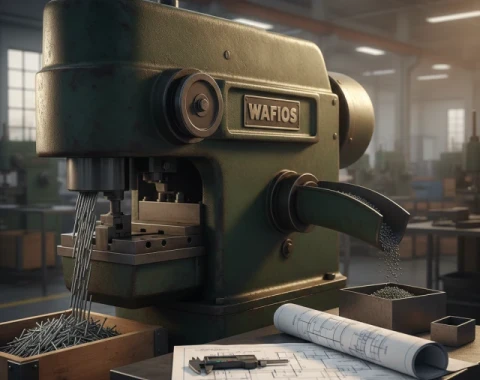
Nagu izgatavošanas iekārtas novērtējums: ko jūs patiesībā pērkat? Eksperta analīze
Savā ikdienas darbā uzņēmumā WeSellMachines es bieži saskaros ar jautājumu, kas virspusēji šķiet pilnīgi racionāls: "Marcin, kāpēc šī 20 gadus vecā Wafios automātiskā mašīna maksā 40 000 eiro, ja es varu iegādāties pavisam jaunu mašīnu ar līdzīgu jaudu no Āzijas importētāja par 15 000 eiro?" Lasīt vairāk

Kā iegādāties lietotu daudzzāģi un revolucionizēt savu kokzāģētavu
Kokapstrādes iekārtu otrreizējais tirgus ir plašs, taču pilns ar slazdiem. Kā eksperts, kurš ir redzējis simtiem iekārtu, kas "nokrāsotas pārdošanai", bet iekšpusē sabojātas, esmu sagatavojis jums šo visaptverošo rokasgrāmatu. Tā nav mārketinga tukša jezga, bet gan pamatīga inženierzinātņu deva, kas ļaus jums patstāvīgi novērtēt iekārtas tehnisko stāvokli. Lasīt vairāk
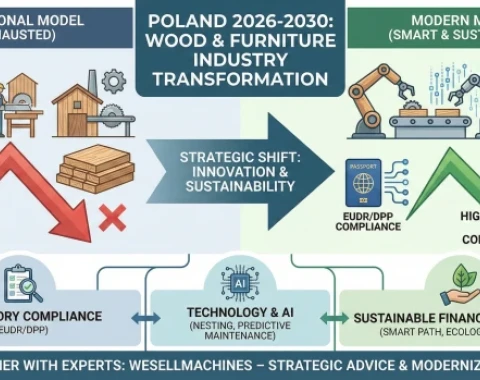
"Lēto mēbeļu" ēras beigas? Jūsu izdzīvošanas un izaugsmes stratēģija 2026.–2030. gadam
Polijas kokapstrādes un mēbeļu rūpniecība gadu desmitiem ir bijusi neapstrīdama līdere eksporta jomā, 2024. gadā radot iespaidīgus 16,3 miljardus eiro. Mēs bijām "mēbeļu rūpnīca Eiropai", uzvarot ar cenu, izejvielu pieejamību un kvalificētu darbaspēku. Tomēr kā praktiķis, kas katru dienu apmeklē jūsu rūpnīcas, es skaidri redzu: šis modelis sāk izsīkt. Lasīt vairāk
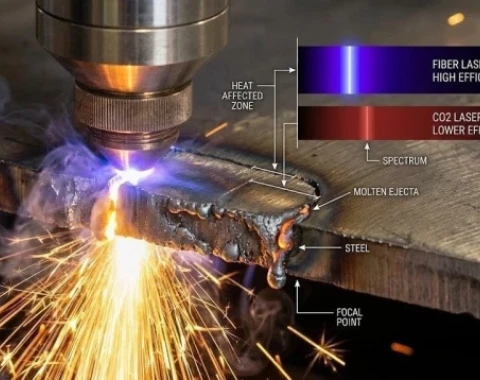
Kopsavilkums: Pašreizējā situācija 2025. gadam
Metālapstrādes nozare nonāk fāzē, kas makroekonomiskajās analīzēs definēta kā "hiperefektivitātes laikmets". Tā kā rūpniecības noskaņojuma indeksi svārstās un tērauda patēriņa prognozes uzrāda tikai nelielu izaugsmi (+2,2%), investīciju kļūdas robeža ir faktiski izzudusi. Vietnē wesellmachines.com mēs identificējam fundamentālu paradigmas maiņu: pāreju no izaugsmes par katru cenu stratēģijas uz aktīvu izmantošanu un naudas plūsmas aizsardzību. Šajā ziņojumā mēs analizējam, kāpēc izdzīvošanas atslēga 2025.–2026. gadā nav "jaunu" preču pirkšana, bet gan "efektīvu" preču pirkšana — bieži vien no otrreizējā tirgus. Lasīt vairāk

Kā izvēlēties lietotu koka CNC apstrādes centru? Pilnīga iekārtas pārbaude soli pa solim
Lietota koka CNC apstrādes centra iegāde ir milzīga iespēja, bet arī milzīgs risks. Iekļautie MDF putekļi iznīcina galvenās sastāvdaļas, un vārpstas vai vakuuma sūkņa remonta izmaksas ir satriecošas. Šī pilnīgā rokasgrāmata (vairāk nekā 5000 vārdu) ir profesionāls tehniskais audits īsumā. Mēs iemācīsim jums, kā soli pa solim pārbaudīt iekārtu — sākot ar vārpstas diagnostiku un vakuuma galda noplūdes testiem līdz mehānikas un vadības ierīču novērtēšanai. Izvairieties no dārgām kļūdām un veiciet pārdomātu ieguldījumu, izmantojot mūsu ekspertu kontrolsarakstu. Lasīt vairāk

Pilnīgs ceļvedis: kā iegādāties lietotu CNC preses bremzi un nenožēlot ieguldījumu
Lietotas CNC lokšņu bremzes iegāde ir stratēģiska, bet riskanta investīcija. Šis raksts ir pilnīgs ceļvedis, kurā soli pa solim ir paskaidrots, kā veikt profesionālu tehnisko pārbaudi, lai samazinātu risku. Autors, eksperts ar 20 gadu pieredzi, apraksta galvenos pārbaudāmos elementus: sākot ar rāmja un hidraulikas novērtēšanu, CNC vadības diagnostiku un beidzot ar dokumentācijas pilnīguma pārbaudi. Raksts sniedz nepieciešamās zināšanas, lai pieņemtu pamatotu un drošu lēmumu, palīdzot izvairīties no dārgām kļūdām. Lasīt vairāk
 Pieslēgties ar Facebook
 Pieslēgties ar Google